Prevalence of Exclusive Breastfeeding among Mothers of Infants in the First Six Months of Life in Riyadh, Saudi Arabia
Prevalence of Exclusive Breastfeeding among Mothers of Infants in the First Six Months of Life in Riyadh, Saudi Arabia
Dr. Abdullah Al Saleh*
*Correspondence to: Dr. Abdullah Al Saleh, Department of Family Medicine and Primary Care/Comprehensive Specialized Clinic, King Abdulaziz Medical City, Riyadh, Saudi Arabia.
Copyright
© 2014: Dr. Abdullah Al Saleh. This is an open access article distributed under the Creative Commons Attribution License, which permits unrestricted use, distribution, and reproduction in any medium, provided the original work is properly cited.
Received: 21 October 2014
Published: 04 November 2014
Abstract
Introduction: Exclusive breastfeeding (EBF) is an essential part of early infant feeding .The WHO recommends that infants should be exclusively breastfed for the first six months of life to achieve optimal growth, development, and health.
Objective: This study was carried out to estimate the prevalence of exclusive breastfeeding among mothers of infants in the first six months of life.
Method: A cross-sectional study was conducted at the National Guard Comprehensive Specialized Clinic in Riyadh, Saudi Arabia. The study population consisted of 500 mother–infant pairs attending the pediatrics clinic. Data were collected by direct interviews using a predesigned questionnaire for the pattern of the feeding.
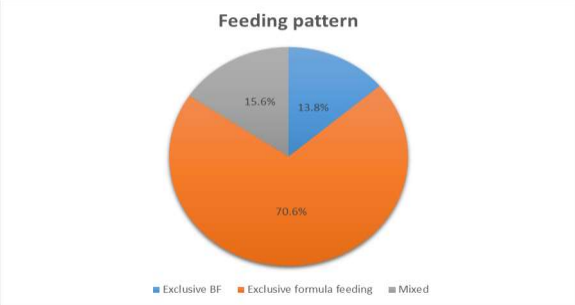
Results: Out of 500 infants enrolled in the study, 69(13.8%) were EBF. The prevalence of exclusive formula feeding and mixed (breast and formula) feeding was 70.6% and 15.6%, respectively.
Conclusion: The majority of mothers presented suboptimal breastfeeding practices. Programs promoting exclusive breastfeeding should therefore vigorously pursue public awareness on EBF practice during the first six months of the life of an infant.
Prevalence of Exclusive Breastfeeding among Mothers of Infants in the First Six Months of Life in Riyadh, Saudi Arabia
Introduction
Breastfeeding is the universally accepted means of infant feeding. Breast milk contains the complete range of nutrients required by infants for healthy growth and development during their first six months of life [1–3]. In addition to these nutrients, breast milk also protects against infections, boosts infant neurodevelopment, and reduces the likelihood of infants with non-communicable diseases, such as cardiovascular diseases, diabetes, obesity, and hypertension later in their life [4,5]. Because of these benefits, the current recommendation of the World Health Organization (WHO) is that all mothers should feed their infants solely with breast milk, exclusive of any other nutritional sources (including plain water and juices), for the first six months of the infant’s life [6]. Globally, just 38% of infants less than six months are exclusively breastfed [7]. In Saudi Arabia, an exclusive breastfeeding (EBF) rate from 0.8% to 43.9%, in babies less than six months of age [8], which is below the optimal EBF rate of 90% in infants < 6 months set by the WHO/UNICEF for developing countries [9]. There are a number of factors, such as undesirable socio-cultural beliefs, poor knowledge of EBF, education, occupation, maternal and infant sicknesses, and many other variables that are intrinsically related to breast feeding practices of the mother [10].
Methods
This cross-sectional study was conducted at the National Guard Comprehensive Specialized Clinic in Riyadh, Saudi Arabia. The study targeted infants from birth until six months of age and their mothers, who attended the pediatrics clinic of the Institute. The study period was from January 2nd, 2014 until February 24th, 2014. Five-hundred mother–infant pairs were enrolled in the study. A purpose-designed, structured questionnaire regarding the type of feeding (Exclusive Breastfeeding, formula or mixed) and the age of the infant was used as a tool for data collection. The response rate was 100%.
Objective
The present study was undertaken to estimate the prevalence of exclusive breastfeeding among mothers of infants in the first six months of life.
Results
Out of 500 infants taken up for study, 69 (13.8%) were exclusively breastfed. The prevalence of exclusive formula feeding and mixed (breast and formula) feeding was 70.6% and 15.6%, respectively (Figure-1).
Figure-1: Prevalence of exclusive breastfeeding (EBF), exclusive formula feeding, and mixed feeding
Discussion
Breastfeeding is an unequaled way of providing ideal food for the healthy growth and development of infants; it is also an integral part of the reproductive process with important implications for the health of mothers [11]. The overall prevalence of EBF of mothers for the first six months of their infant’s life in this study was 13.8%. This result showed less prevalence of EBF as compared to previous results by El-Gilanyf [12] in which he found the prevalence of EBF in Saudi Arabia to be 24.4% and 31.4%, respectively. There is a is wide variation in the rates of EBF in earlier regional reports in Saudi Arabia, which ranged from 0.8 to 43.9% [11]. The noticeable variation between these studies indicates the importance of carrying out standardized national surveys covering all regions in the country to find out the national rate of EBF and to map the actual disparities between regions. The results of this cross?sectional study and many other studies in Saudi Arabia revealed the low rates of exclusive breastfeeding as practiced regionally, and confirmed that it is still far away from the widely accepted “universal coverage” target recommended by WHO/UNICEF that there should be 90% EBF in children less than 6 months in developing countries [9]. National surveys should be conducted on a regular basis to observe the progress of the national strategies for breastfeeding promotion. There is also a need for educational interventions to improve rates of exclusive breastfeeding in Saudi Arabia.
Conclusion
The rate of exclusive breastfeeding in infants less than six months of age was 13.8%. This finding showed that maternal EBF practice in this study was lower than the WHO recommendation. It also indicates the need for programs promoting EBF in order to raise public awareness of EBF practices during the first six months of life.
References
1. 1. Agostoni C, Scaglioni S, Ghisleni D, Verduci E, Giovannini M, Riva E. How much protein is safe? Int J Obes. 2005; 29:S8-S13.
2. Baker JL, Michaelsen KF, Rasmussen KM, Sorensen TI. Maternal prepregnant body mass index, duration of breastfeeding, and timing of complementary food introduction are associated with infant weight gain. Am J Clin Nutr. 2004; 80:1579-1588.
3. Esteves TM, Daumas RP, Oliveira MI, Andrade CA, Leite IC. Factors associated to breastfeeding in the first hour of life: systematic review. Rev Saude Publica. 2014; 48:697-708.
4. Koletzko B, Shamir R, Ashwell M. Quality and safety aspects of infant nutrition. Ann Nutr Metab. 2012;
60:179-184.
5. Verduci E, Banderali G, Barberi S, et al. Epigenetic effects of human breast milk. Nutrients. 2014; 6:1711-1724
6. World Health Organization (WHO) and UNICEF. Global Strategy for Infant and Young Child Feeding. Geneva, Switzerland: WHO, 2003.
7. United Nation Children’s Fund. Nutrition; Improving breastfeeding, complementary foods and feeding practices. New York: United Nation Children’s Fund, 2015.
8. D. A. Al Juaid, C. W. Binns, and R. C. Giglia, “Breastfeeding in Saudi Arabia: a review,” International Breastfeeding Journal, vol. 9, no. 1, 2014.
9. World Health Organization (WHO), Regional Office for the Eastern Mediterranean. Regional Strategy on Nutrition 2010–2019/, World Health Organization (WHO), Geneva, Switzerland, 2011, https://applications.emro.who.int/dsaf/ dsa1230.pdf.
10. Dungy CI, Losch M, Russell D. Maternal attitudes as predictors of infant feeding decisions. Journal of the Association for Academic Minority Physicians. 1994; 5:159-164.
11. World Health Organization (WHO), Breastfeeding Overview, World Health Organization (WHO), Geneva, Switzerland, 2020, https://www.who.int/health-topics/breastfeeding#tab2.
12. Abdel-Hady El-Gilany, Ebrahim Shady. Exclusive Breastfeeding in Al-Hassa, Saudi Arabia. Breastfeeding medicine, 2011, 6, 4.