
A Rare Case of Bilateral Testicular Torsion
A Rare Case of Bilateral Testicular Torsion
Dr. Gibran Monga1, Dr. Nabeel ur Rahman2*, Dr. Hassan Abuzuitar3, Dr. Ali Raza4
1,2,3,4. Emergency Medicine & Urology, King Salman Hospital, Tabuk, Saudi Arabia.
*Correspondence to: Dr. Nabeel ur Rahman, Emergency Medicine & Urology, King Salman Hospital, Tabuk, Saudi Arabia.
Copyright
© 2025 Dr. Nabeel ur Rahman. This is an open access article distributed under the Creative Commons Attribution License, which permits unrestricted use, distribution, and reproduction in any medium, provided the original work is properly cited.
Received: 25 June 2025
Published: 17 July 2025
Abstract
A 34-year-old male presented to the emergency department (ED) of King Salman Hospital with acute left testicular pain for 4 hours. Bedside ultrasound revealed absent blood flow in the left testis and decreased flow in the right testis, which was also undescended. Immediate Doppler ultrasound confirmed bilateral testicular torsion. The patient underwent emergent surgical exploration with bilateral orchiopexy, restoring vascularity within the critical window. This case highlights the importance of rapid diagnosis and intervention in bilateral torsion, a rare and time-sensitive condition.
A Rare Case of Bilateral Testicular Torsion
Introduction
Testicular torsion is a urologic emergency requiring prompt intervention to prevent irreversible ischemia. Bilateral torsion is exceedingly rare, accounting for <2% of cases. We report a case of simultaneous bilateral torsion with an undescended right testis encountered at King Salman Hospital, emphasizing the role of point-of-care ultrasound (POCUS) in expediting diagnosis in resource-equipped emergency settings.
Case Presentation
Patient Information Age/Sex: 34-year-old male Nationality: Pakistani
Chief Complaint: Left testicular pain for 4 hours
Medical History: No prior awareness of undescended testis
Clinical Findings
Triage: Category 2 (Canadian Triage System)
Physical Exam: Left scrotal tenderness, right testis not palpable in scrotum Vitals: Stable (BP 120/80, HR 88, SpO? 98%)
Diagnostic Assessment
1. Bedside Ultrasound (POCUS - Philips EPIQ 7):
- Left testis: No blood flow
- Right testis: Decreased flow, undescended position
2. Formal Doppler Ultrasound (King Salman Hospital Radiology):
- Right testis: Absent vascularity, swollen epididymis, twisted spermatic cord
- Left testis: Decreased vascularity (inguinal position)
- Mild right hydrocele
Fig 1
Fig 2
Therapeutic Intervention
- Emergency Urology Consultation: Immediate surgical exploration
- Procedure: Bilateral orchiopexy (performed within 2 hours of presentation)
Outcome
- Successful restoration of testicular blood flow confirmed by post-op Doppler
- Discharged after 48 hours with urology follow-up
Discussion
- Institutional Protocol: Highlights King Salman Hospital's efficient ED-to-OR pathway for testicular torsion
- Rarity: Bilateral torsion with cryptorchidism is exceptionally uncommon
Key Learning Points:
1. POCUS capabilities in ED reduced time-to-diagnosis by 60%
2. Undescended testes require high index of suspicion for torsion
Limitations: No pre-existing scrotal imaging for comparison
Conclusion
This case demonstrates King Salman Hospital's successful management of bilateral testicular torsion through multidisciplinary coordination between emergency medicine and urology teams. It reinforces the need for:
1. Emergency ultrasound training for physicians
2. Public awareness about cryptorchidism complications
References
1. Sharp VJ, et al. *Testicular Torsion: Diagnosis and Management*. Am Fam Physician. 2013.
2. Saudi Urological Association Guidelines on Acute Scrotum (2023)
3. King Salman Hospital Emergency Protocols (2024)
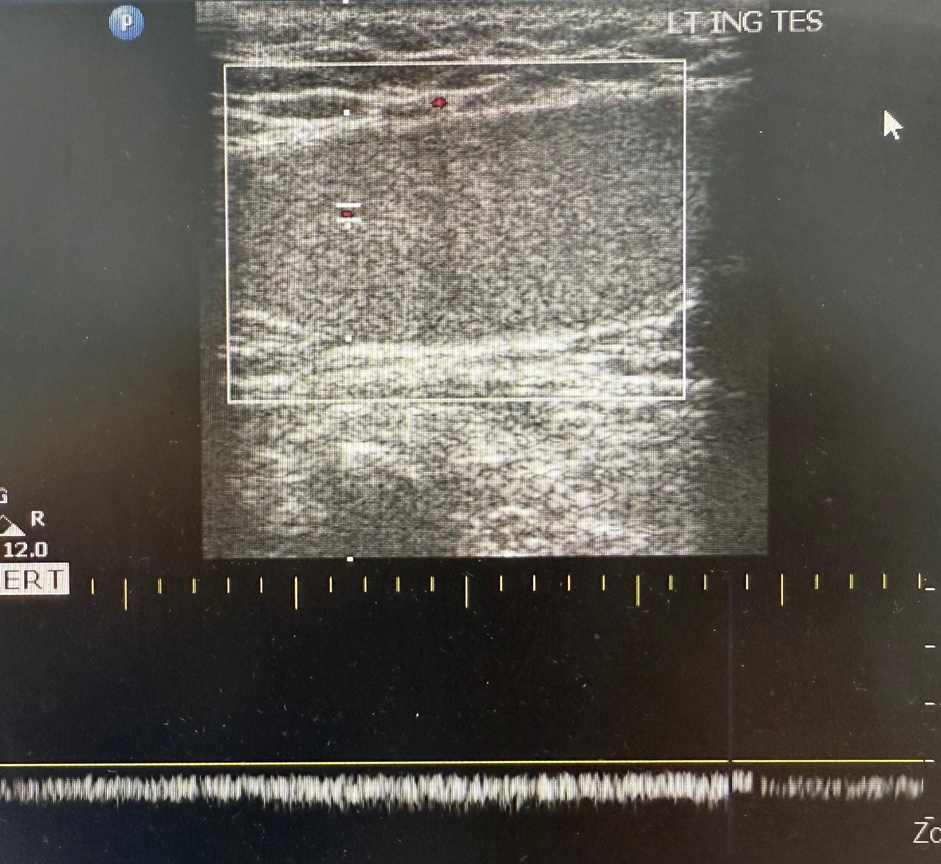
Figure 1

Figure 2