
Rapid Radiographic Healing in a Failed Tooth #36 with Large Periapical and Furcation Lesion Following Retreatment Using nRoot Bioceramic Sealer: A 7-Month Case Report.
Rapid Radiographic Healing in a Failed Tooth #36 with Large Periapical and Furcation Lesion Following Retreatment Using nRoot Bioceramic Sealer: A 7-Month Case Report.
Dr. Ahmed Abo Elkhier *
*Correspondence to: Dr. Ahmed Abo Elkhier, Specialist in Endodontics, Ahmed Abo Elkhier Dental Clinic, Mansoura, Egypt
Copyright.
© 2025 Dr. Ahmed Abo Elkhier This is an open access article distributed under the Creative Commons Attribution License, which permits unrestricted use, distribution, and reproduction in any medium, provided the original work is properly cited.
Received: 17 July 2025
Published: 25 July 2025
DOI: https://doi.org/10.5281/zenodo.17053066
ABSTRACT
Background: Large periapical and bifurcation lesions in failed endodontic cases pose significant challenges for regenerative healing.
Case Presentation: A 44?year?old medically free female presented with intermittent pain, exudate, and odour from the lower left (#36). Clinical and radiographic evaluation revealed a previously treated tooth with chronic periapical abscess, large periapical radiolucency, and complete loss of bifurcation bone. Retreatment was performed using rotary instrumentation to 25/.06, calcium hydroxide medication, sonic-assisted irrigants, and obturation with nRoot bioceramic sealer via single-cone technique. Restoration with fiber-reinforced composite followed. At 7-month follow?up, rapid bone regeneration was observed, including bifurcation area; radiopaque sealer residues evident.
Conclusion: nRoot (ENP Biotechnology) shows promising bioactivity and radiopacity, fostering rapid healing in complex lesions. Further studies are warranted.
Rapid Radiographic Healing in a Failed Tooth #36 with Large Periapical and Furcation Lesion Following Retreatment Using nRoot Bioceramic Sealer: A 7-Month Case Report.
Introduction
Failed root canal treatments with extensive periapical and furcation lesions are difficult to manage and often require surgical intervention or extraction. Bioceramic sealers, especially those based on hydraulic calcium silicates, release calcium ions, increase alkalinity (pH?>?12), and promote mineralization and antimicrobial environments. nRoot (ENP Biotechnology, China) is a resin-free, premixed bioactive sealer containing tricalcium silicate, dicalcium silicate, and zirconium oxide radiopacifier, with a setting time of ~4?h and high radiopacity.
Case Presentation
Patient: 44-year-old female, medically free, presented with intermittent pain, exudate, and malodor in Tooth (#36), seeking to save the tooth.
Clinical Examination:
- Percussion : +
- palpation : ++
- Mobility: Grade I
- Probing depths: 5 mm at buccal furcation, 1–2 mm all aspects
Radiographic Findings:
Large periapical radiolucency with Noticed bone loss in the furcation area .
Diagnosis:
Previous Endodontically treated Tooth #36 with chronic periapical abscess & Bifurcation Area Involvement ( Endo-Perio Lesion , Endo First )
Treatment Procedure:
- Retreatment under rubber dam isolation
- Instrumentation to 25/.06 with Videya TC?Blue rotary Files
- Intracanal medication: Calcium hydroxide for 10 days
- Irrigation protocol: 5.25% NaOCl, 17% EDTA, 2% CHX with sonic activation
- Obturation: Single-cone hydraulic condensation with nRoot bioceramic sealer
- Restoration: Fiber-reinforced composite coronal seal
Follow-Up:
At 7 months, radiographs showed substantial periapical and furcation bone regeneration. Radiopaque remnants (“sealer puff”) were visible but asymptomatic. Clinically, no pain or mobility; probing depths reduced.
Figure 1. Pre-operative radiograph of tooth #36 showing extensive periapical radiolucency and complete loss of bone in the furcation area.
Figure 2. Immediate post-operative radiograph of tooth #36 following retreatment.
Figure 3. 7-month follow-up radiograph showing significant bone regeneration and radiopaque sealer remnants.
Figure 4. Clinical photographs before and after treatment (rubber dam isolation and final composite restoration)
Discussion
The rapid healing observed aligns with previous reports on hydraulic calcium silicate sealers encouraging mineralized tissue formation via high pH and calcium ion release. The visible sealer residue is common in single-cone techniques with bioceramics and does not indicate pathology. Compared to other sealers, nRoot offers high radiopacity, ease of use, resin-free formulation, and good biocompatibility. Limitations include being a single case report, lack of histologic confirmation, and moderate follow-up duration. Further controlled trials comparing healing rates would be valuable.
Conclusion
This case highlights the potential of nRoot bioceramic sealer in promoting significant bone healing in large periapical and furcation lesions within 7 months. Its bioactive properties and high radiopacity offer advantages in complex endodontic retreatments.
References
1. Viapiana R, et al. A critical review of the material properties guiding the clinician’s choice of root canal sealers. Int Endod J. 2024.
2. Candeiro GTM, Correia FC, Duarte MAH, et al. Evaluation of the physical properties of a new calcium silicate-based sealer. Braz Dent J. 2020;31(2):140-146.
3. Zhang W, Li Z, Peng B. Assessment of a new root canal sealer’s apical sealing ability. Oral Surg Oral Med Oral Pathol Oral Radiol Endod. 2009;107(6):e79-e82.
4. Camilleri J. Sealers and warm gutta-percha obturation techniques. J Endod. 2015;41(1):72-78.
5. Zhou HM, Shen Y, Zheng W, et al. Physical properties of 5 root canal sealers. J Endod. 2013;39(10):1281-1286.
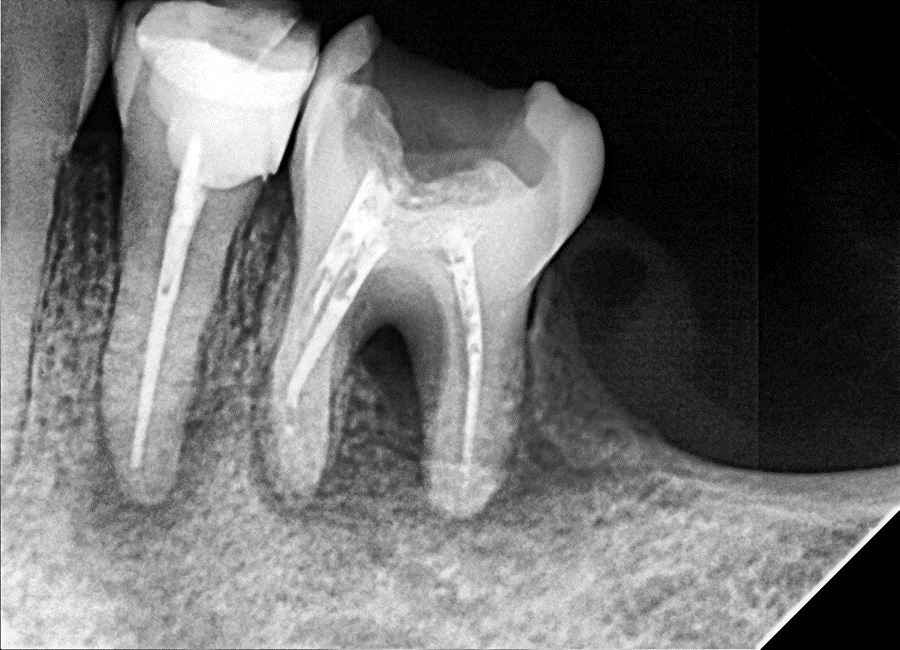
Figure 1

Figure 2

Figure 3

Figure 4