
Impact of Maternal Oral Health on Infant Oral Outcomes: A Concise Narrative Review (2015–2025).
Dr. Saurabh Hire*
*Correspondence to: Dr. Saurabh Hire, BDS, Indiana University, Indianapolis.
Copyright.
© 2025 Dr. Saurabh Hire, This is an open access article distributed under the Creative Commons Attribution License, which permits unrestricted use, distribution, and reproduction in any medium, provided the original work is properly cited.
Received: 17 Oct 2025
Published: 25 Oct 2025
https://doi.org/10.5281/zenodo.17464483
ABSTRACT
Background: Maternal oral health may influence infant oral outcomes through biological, behavioral, and social pathways. Clear synthesis of recent, freely accessible evidence can inform prenatal and early-life preventive strategies.
Objective: To synthesize PubMed/PMC (2015–2025) free full-text evidence on the association between maternal oral health (caries, periodontal disease, oral microbiota, oral health literacy) and infant oral outcomes (early childhood caries [ECC], enamel defects, microbial colonization, and birth-related factors).
Methods: I searched for PubMed/PMC for human studies published between 1 January 2015 and September 2025 using combinations of terms for maternal oral health and infant outcomes. Filters: English, free full text (PMC). Both original research and review articles reporting maternal exposures and infant outcomes for children aged 0–2 years were eligible. Data were extracted into a standardized spreadsheet and synthesized narratively.
Results: Twenty PMC-accessible articles met inclusion. Evidence consistently supports maternal to infant microbial transmission of cariogenic organisms. Multiple observational studies report positive associations between untreated maternal caries and higher ECC risk in offspring. Maternal periodontal disease is associated with adverse pregnancy outcomes; evidence for a direct independent effect on infant ECC is mixed. Maternal oral-health literacy, behaviors, and access to prenatal dental care emerged as modifiable pathways and intervention targets.
Conclusions: Maternal oral health appears to be an important determinant of early infant oral outcomes. Priorities include prenatal dental-care access, maternal oral-health education, and longitudinal intervention trials to determine whether improving maternal oral health reduces ECC incidence.
Keywords: maternal oral health; early childhood caries; Streptococcus mutans; prenatal dental care; infant oral health; narrative review.
Impact of Maternal Oral Health on Infant Oral Outcomes: A Concise Narrative Review (2015–2025).
Introduction
Early life represents a pivotal period for oral-health trajectories. Maternal oral health can shape infant oral outcomes through multiple pathways: direct vertical microbial transmission (e.g., Streptococcus mutans), shared household behaviors and dietary patterns, and pregnancy-related biological mechanisms (e.g., systemic inflammation associated with maternal periodontal disease that may influence pregnancy outcomes). Understanding these linkages is important for designing preventive strategies that begin in pregnancy and extend into the first years of life.
This concise narrative review synthesizes accessible literature (PubMed/PMC, 2015–2025) that examined maternal oral-health exposures and infant oral outcomes (children aged 0–2 years). My goal is to summarize consistent findings, highlight mechanistic pathways, identify modifiable intervention points, and suggest priorities for future research and policy.
Methods
Search strategy and eligibility:
I searched PubMed/PMC for articles published between 1 January 2015 and September 2025 using combinations of keywords for maternal oral health (e.g., 'maternal oral health', 'maternal caries', 'periodontal disease') and infant outcomes (e.g., 'early childhood caries', 'ECC', 'enamel hypoplasia', 'Streptococcus mutans'). Filters: human studies, English language, and free full text available via PMC. Both original research and review articles reporting maternal exposures and infant outcomes for children aged 0–2 years were included.
Screening and data extraction:
Titles and abstracts were screened for relevance. Full texts for potentially eligible studies were retrieved. Data were extracted into a standardized spreadsheet recording: author/year, country, study design, sample size, maternal exposure(s), infant outcome(s), principal finding(s), effect measures when reported, and study limitations. Because included studies varied in design and outcome measurement, I performed a narrative synthesis organized by a priori themes: microbial transmission, maternal caries and ECC, periodontal disease and pregnancy/infant outcomes, and maternal knowledge/behavior/interventions.
Reporting:
This manuscript follows a concise narrative review format rather than a systematic review or meta-analysis; methods are oriented toward transparent reproducibility (search dates and filters provided) rather than exhaustive quantitative pooling.
Results
Included studies:
Twenty PMC-accessible articles published between 2015–2025 met the inclusion criteria. A full study-level extraction table is provided in Table 1.
1) Evidence for maternal to infant microbial transmission
Multiple culture-based and genotyping studies show that mothers frequently carry the same cariogenic strains found in their infants, and infants born to mothers with higher cariogenic bacterial loads are more likely to be colonized earlier. Studies using S. mutans isolation or molecular genotyping (e.g., Damle et al., 2016; Latifi-Xhemajli et al., 2021; Childers et al., 2017; de Souza et al., 2015) demonstrate marked mother–child strain similarity and earlier infant colonization in higher-load maternal cases. Reviews and syntheses (e.g., Azevedo et al., 2023) contextualize transmission alongside behavioral routes such as shared utensils and feeding practices.
2) Maternal caries and association with early childhood caries
Several cohort and cross-sectional studies report positive associations between maternal untreated caries and the presence or risk of ECC in offspring (e.g., Foxman et al., 2023; de Souza et al., 2015; Haque et al., 2023). Although effect sizes and adjustment covariates vary across studies, the general trend indicates that children of mothers with active caries or high caries experience are at greater risk of early caries development, often mediated by shared behavioral risk factors.
3) Maternal periodontal disease and pregnancy / infant outcomes
Systematic reviews and meta-analyses (e.g., Daalderop et al., 2018; Zhang et al., 2022) identify associations between maternal periodontal disease and adverse pregnancy outcomes (preterm birth, low birth weight). These pregnancy outcomes are risk factors for broader child health vulnerabilities and may indirectly influence oral-health trajectories. Evidence directly linking maternal periodontal disease to infant ECC is less consistent; heterogeneity in periodontal measures and timing of assessment limits firm conclusions.
4) Maternal knowledge, behaviors, and prenatal dental-care interventions
Maternal oral-health literacy and care-seeking behavior associate with infant oral-health behaviours and early outcomes (e.g., BaniHani et al., 2021; Alade et al., 2021; Rai & Tiwari, 2018). Emerging intervention and pilot cohort data (e.g., Yang et al., 2024; small-pilot PTOR designs) suggest prenatal dental rehabilitation and maternal education may improve maternal oral status and hold promise for downstream infant benefits; however, large-scale randomized trials remain limited.
Discussion
Synthesis:
Across PMC-accessible literature from 2015–2025, three consistent messages emerge. First, vertical transmission of cariogenic organisms from mother to child is well-documented and is a plausible proximal mechanism for early colonization and subsequent ECC risk. Second, untreated maternal caries is repeatedly associated with higher ECC prevalence or risk in children; much of this effect is plausibly mediated by household behaviors and shared environments. Third, while maternal periodontal disease is associated with adverse pregnancy outcomes in several syntheses, its direct role in infant ECC is less uniform in the literature.
Mechanisms and pathways:
The strong evidence for mother–child microbial sharing does not exclude the importance of behavioral and social determinants. Feeding practices (prolonged bottle feeding, nighttime feeding with cariogenic liquids), hygiene behaviours, and socio-economic constraints shape exposure to cariogenic risk. Inflammatory pathways linked to periodontal disease may influence fetal development or birth outcomes, thus indirectly affecting infant vulnerability.
Implications for practice:
Findings support integrating oral-health promotion into antenatal care: prenatal oral-health screening, provision of needed dental care during pregnancy, and maternal education about feeding and hygiene can be pragmatic, potentially high-impact interventions. Early infant preventive visits (starting in infancy) and caregiver education should be embedded into maternal and child health programs.
Limitations of the evidence and this review:
The primary literature is dominated by observational designs, often with small or convenience samples and differing outcome definitions and microbial methods, limiting comparability and causal inference. This review intentionally limited inclusion to free full-text PMC articles to ensure reproducibility and accessibility; this approach may have excluded high-quality paywalled research. Our narrative approach prioritized clarity and synthesis over quantitative pooling.
Research priorities:
High-priority studies include longitudinal cohorts measuring serial maternal and infant microbiomes with standardized ECC outcomes, and randomized or pragmatic trials testing prenatal maternal dental treatment or maternal-behavior interventions with infant ECC as an outcome. Implementation studies are also needed to identify how best to integrate oral health into routine pregnancy care, especially in low-resource settings.
Conclusions
Maternal oral health, particularly untreated caries and high cariogenic bacterial load is an important determinant of early infant oral outcomes. Strengthening prenatal dental-care access, improving maternal oral-health literacy, and implementing maternal-targeted preventive interventions are promising public-health strategies to reduce early childhood caries. High-quality longitudinal and interventional studies are needed to establish causality and inform policy.
Author contribution:
Dr. Saurabh Hire conceived the review, performed the search and data extraction, drafted the manuscript, and prepared the table and figure.
Funding: No external funding was received for this manuscript.
Conflicts of interest:The author declare no conflicts of interest.
Ethics: This study is a narrative review of published literature and did not require institutional review board approval.
References
1. Foxman, B., Davis, E., Neiswanger, K., McNeil, D., Shaffer, J., & Marazita, M. L. (2023). Maternal factors and risk of early childhood caries: A prospective cohort study. Community Dentistry and Oral Epidemiology, 51(5), 953–965. https://doi.org/10.1111/cdoe.12794
2. Latifi-Xhemajli, B., Rexhepi, A., Veronneau, J., Kutllovci, T., Ahmeti, D., & Bajrami, S. (2021). Streptococcus Mutans infections in infants and related maternal/child factors. Acta Stomatologica Croatica, 55(3), 308–315. https://doi.org/10.15644/asc55/3/8
3. De Souza, P. M. D. E. S., Proença, M. A. M., Franco, M. M., Rodrigues, V. P., Costa, J. F., & Costa, E. L. (2015). Association between early childhood caries and maternal caries status: A cross-section study in São Luís, Maranhão, Brazil. European Journal of Dentistry, 9(1), 122–126. https://doi.org/10.4103/1305-7456.149659
4. Damle, S. G., Yadav, R., Garg, S., Dhindsa, A., Beniwal, V., Loomba, A., & Chatterjee, S. (2016). Transmission of mutans streptococci in mother-child pairs. The Indian Journal of Medical Research, 144(2), 264–270. https://doi.org/10.4103/0971-5916.195042
5. Azevedo, M. J., Garcia, A., Costa, C. F. F. A., Ferreira, A. F., Falcão-Pires, I., Brandt, B. W., Ramalho, C., Zaura, E., & Sampaio-Maia, B. (2023). The contribution of maternal factors to the oral microbiota of the child: Influence from early life and clinical relevance. The Japanese Dental Science Review, 59, 191–202. https://doi.org/10.1016/j.jdsr.2023.06.002
6. BaniHani, A., Tahmassebi, J., & Zawaideh, F. (2021). Maternal knowledge on early childhood caries and barriers to seek dental treatment in Jordan. European Archives of Paediatric Dentistry, 22(3), 433–439. https://doi.org/10.1007/s40368-020-00576-0
7. Haque, F., Folayan, M. O., & Virtanen, J. I. (2023). Maternal factors associated with early childhood caries among 3–5-year-old children with low socio-economic status in Trishal, Bangladesh. Frontiers in Oral Health, 4, 1244359. https://doi.org/10.3389/froh.2023.1244359
8. Childers, N. K., Momeni, S. S., Whiddon, J., Cheon, K., Cutter, G. R., Wiener, H. W., Ghazal, T. S., Ruby, J. D., & Moser, S. A. (2017). Association between early childhood caries and colonization with Streptococcus mutans genotypes from mothers. Pediatric Dentistry, 39(2), 130–135
9. Nizar, A., Sheikh, M., Khan, F. R., Iqbal, N. T., Azam, S. I., Qureshi, S., Ali, A., & Jehan, F. (2022). Streptococcus mutans carriage in the saliva of mothers and its association with dental caries and Streptococcus mutans carriage in the saliva of children between 6 and 30 months old in a low-income setting in Karachi, Pakistan. Clinical and Experimental Dental Research, 8(6), 1523–1532. https://doi.org/10.1002/cre2.648
10. Yenen, Z., & Ataça?, T. (2019). Oral care in pregnancy. Journal of the Turkish German Gynecological Association, 20(4), 264–268. https://doi.org/10.4274/jtgga.galenos.2018.2018.0139
11. Kumar, J., Crall, J. J., & Holt, K. (2023). Oral health of women and children: Progress, challenges, and priorities. Maternal and Child Health Journal, 27(11), 1930–1942. https://doi.org/10.1007/s10995-023-03757-7
12. Rai, N. K., & Tiwari, T. (2018). Parental factors influencing the development of early childhood caries in developing nations: A systematic review. Frontiers in Public Health, 6, 64. https://doi.org/10.3389/fpubh.2018.00064
13. Anil, S., & Anand, P. S. (2017). Early childhood caries: Prevalence, risk factors, and prevention. Frontiers in Pediatrics, 5, 157. https://doi.org/10.3389/fped.2017.00157
14. Alade, M., Folayan, M. O., El Tantawi, M., Oginni, A. B., Adeniyi, A. A., & Finlayson, T. L. (2021). Early childhood caries: Are maternal psychosocial factors, decision-making ability, and caries status risk indicators for children in a sub-urban Nigerian population? BMC Oral Health, 21(1), 73. https://doi.org/10.1186/s12903-020-01324-y
15. Daalderop, L. A., Wieland, B. V., Tomsin, K., Reyes, L., Kramer, B. W., Vanterpool, S. F., & Been, J. V. (2018). Periodontal disease and pregnancy outcomes: Overview of systematic reviews. JDR Clinical and Translational Research, 3(1), 10–27. https://doi.org/10.1177/2380084417731097
16. Zhang, Y., Feng, W., Li, J., Cui, L., & Chen, Z. J. (2022). Periodontal disease and adverse neonatal outcomes: A systematic review and meta-analysis. Frontiers in Pediatrics, 10, 799740. https://doi.org/10.3389/fped.2022.799740
17. Alrashdi, M. (2024). Influences of maternal nutrition and lifestyle factors on early childhood oral health: A systematic review of mechanisms and intervention strategies. Children (Basel, Switzerland), 11(9), 1107. https://doi.org/10.3390/children11091107
18. Yang, R., Rashwan, N., Al Jallad, N., Wu, Y., Lu, X., Wu, T., & Xiao, J. (2024). Maternal and infant oral health benefits from mothers receiving prenatal total oral rehabilitation: A pilot prospective birth cohort study. Frontiers in Oral Health, 5, 1443337. https://doi.org/10.3389/froh.2024.1443337
19. Córdova-Carrillo, K., De la Peña-Lobato, C., Cuevas-González, M. V., Cuevas-González, J. C., Espinosa-Cristóbal, L. F., Tovar-Carrillo, K. L., Saucedo-Acuña, R. A., Zambrano-Galván, G., & Reyes-López, S. Y. (2024). Importance of human breast milk in the early colonization of Streptococcus mutans. Medicina (Kaunas, Lithuania), 60(8), 1308. https://doi.org/10.3390/medicina60081308
20. Kamolchaiwanich, K., Lee, J. Y., & Leelataweewud, P. (2025). Exploring the link between maternal oral health literacy and child oral health behaviours. International Dental Journal, 75(3), 2042–2052. https://doi.org/10.1016/j.identj.2024.12.033
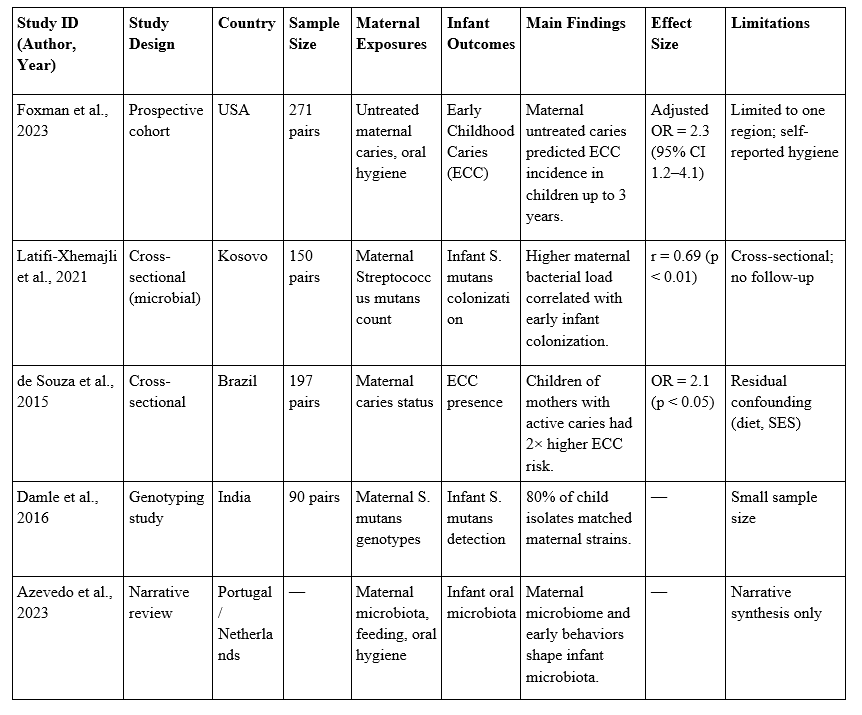
Figure 1
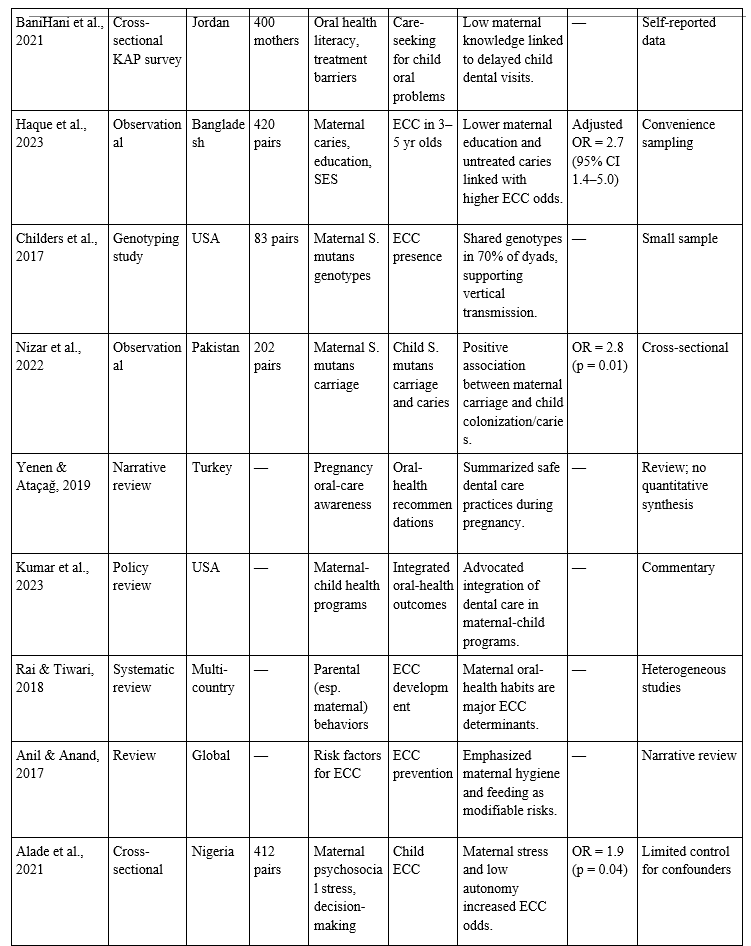
Figure 2
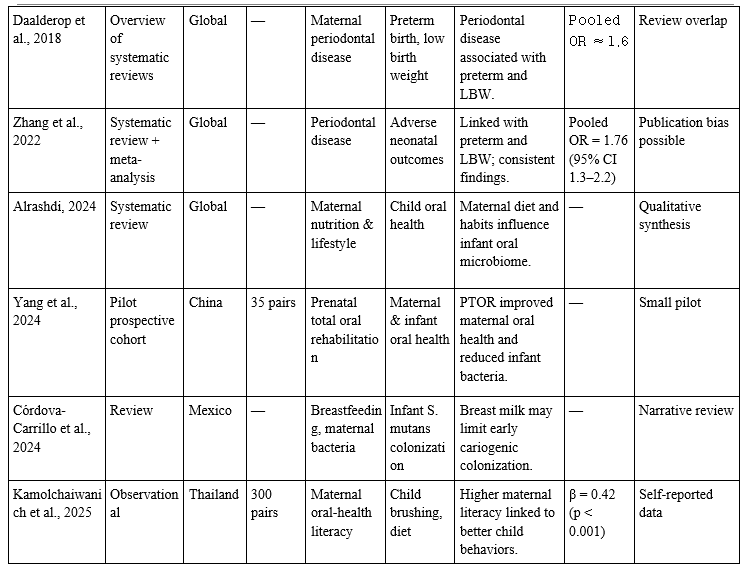
Figure 3
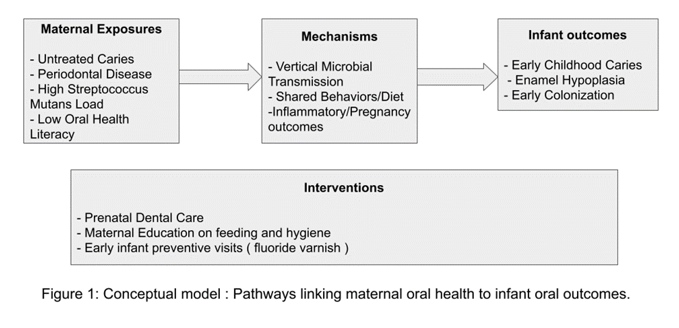
Figure 4